Most anglers don't need a better rod. They need a better setup on the spinning rod and reel combo they already own. I have watched a paying client lose a slot redfish because his drag was cranked down to nothing and his knot was a clinch knot tied in a hurry at the dock. The rod was fine. The reel was fine. The setup was the problem, and the setup is the one part of fishing that is entirely in your hands.
A spinning rod and reel combo comes down to four things: matching the gear to the fish you actually catch, balancing the rod and reel so the outfit doesn't fight you, spooling line so it comes off the spool without twist, and setting a drag that gives line before your leader or your rod gives out.
None of that takes a tackle shop's worth of tools. It takes about 30 minutes at the kitchen table and the willingness to redo it when it's wrong.
I ran charters out of Destin for 24 years before my knees voted me out of the boat. Now I run the tackle shop and I test gear full time. This is the same walkthrough I give every customer who walks out the door with a combo in a bag, and it is the same one I'd give my own kid.
Why you should trust me
Twenty-four years of putting beginners on fish teaches you what actually matters, and it is not the number on the price tag. I have spooled more line than most factories, I keep a logbook of every rod's action curve, and every rod that comes through my hands gets the same treatment: a full season of real fishing, a backbone test against a 40 pound drag, and a long morning of casting to see whether the tip loads clean and comes back straight.
My rules are simple. No review without at least 20 real trips on the water. No fish-fighting claim without an actual drag test. No rod review without a casting test from both a beginner and an expert, because the two of them feel different things in the same blank.
What that means for you is that the advice below is about technique, not marketing. I sell expensive rods in my shop and I fish a 15 year old medium action most weekends. The rod is a tool. The fish is the review.
How I judged the two combos below
This is not a shootout between a $60 outfit and a $300 outfit. I am not going to pretend they fish the same, and neither should you. The two combos here were picked for two different jobs, and both of them answer the same four questions I ask about any rod before it earns a spot in a recommendation.
How does it load on a real cast? Does the backbone hold through the mid-section when a fish turns and runs? Do the guides survive a season of salt and sun without grooving? And would I hand it to a paying client without checking on them every five minutes?
The other thing I look at is the reel seat. A wobbly reel seat on a 20 pound fish is a disaster waiting to happen, and it is the first thing to fail on cheap combos. Grab the reel and try to rock it side to side. If it moves, walk away, or fix it before you fish it.
Action is the spec that actually matters, not power. A fast action bends in the top third and gives you a crisp, accurate cast. A moderate action bends through the middle and is more forgiving on a hookset. For most freshwater fish and most inshore saltwater, a moderate to moderate-fast action will out-fish a broomstick every day of the week.
The gear that starts the setup right
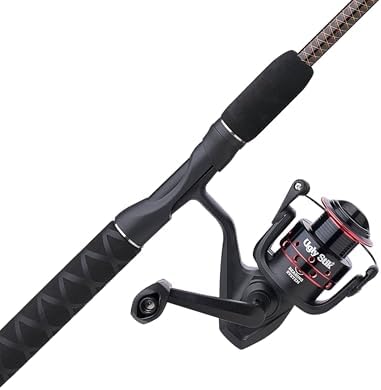
The workhorse pick: Ugly Stik GX2 Spinning Reel and Fishing Rod Combo
 Visit on Amazon →
Check current Amazon price. Ugly Stik has been the value king in my shop for as long as I have had a shop, and the GX2 combo is the reason. It is the combo I put in a beginner's hands when they tell me they want to fish ponds, lakes, and the back bays without spending a mortgage payment. The blank is the part that earned the reputation: it takes abuse that would turn a graphite rod into a two piece rod in the worst way. The action is good enough for 90 percent of anglers, which is a sentence I do not write often.
Where it fits is simple. If you are going to throw a bobber and a worm at a farm pond on Saturday, then throw a jig head at a dock on Sunday, this is the outfit that does both without you worrying about it. It comes as a matched rod and reel, so the balance is already worked out for you, which removes the single most common mistake a new angler makes when they buy a rod and a reel separately.
Flaws but not dealbreakers: A combo reel at this level is not going to have the drag smoothness of a reel you buy on its own, and the guides are not the premium rings you'd find on a mid-range rod. That is the trade. What you get in return is an outfit you can hand to a kid or a guest and not think about again.
Anyone learning to fish, or anyone who wants a truck rod that lives behind the seat and never gets babied, is the right owner for this combo.
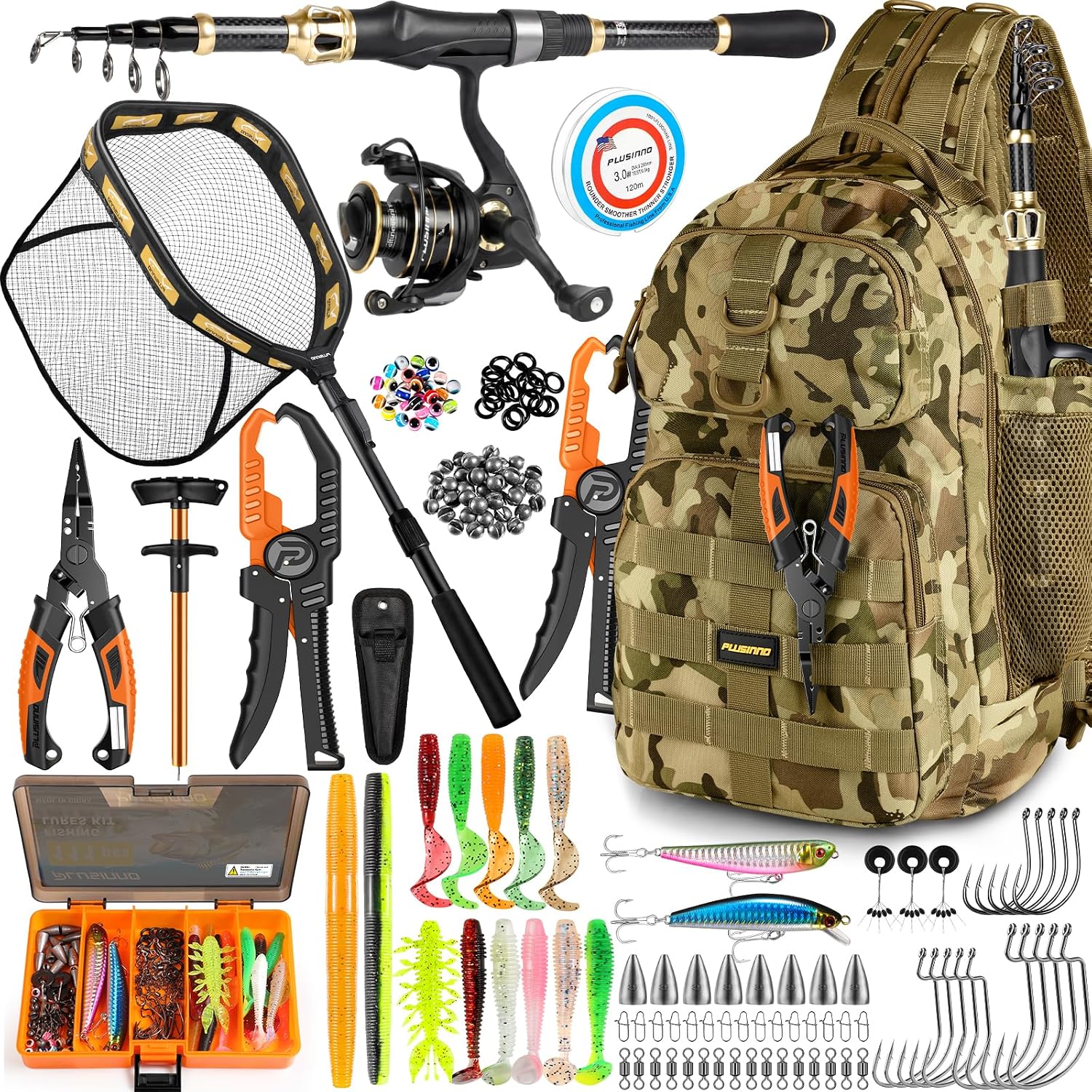
The everything-in-one pick: PLUSINNO Fishing Gear-Fishing Rod & Fishing Backpack, Fish Net, Tackle Box
 Visit on Amazon →
Check current Amazon price. This one solves a different problem, and it is the problem most beginners don't see coming: where does all the rest of it go. A rod and reel alone does not land a fish. You still need a net, a place for your tackle, and something to carry it in when you are walking a bank or wading a flat.
What this package puts together is a rod, a backpack, a fish net, and a tackle box as one purchase. For someone starting from zero, that is the difference between one order and four, and it means you show up to the water with everything in one bag instead of realizing at the ramp that your net is in the garage.
The backpack is the part I care about most, because line management and tackle management are the same skill wearing different hats. A bag that keeps your boxes organized keeps you from digging for a hook while a fish is running. The included net matters too, especially if you plan to release fish, because lipping a fish on a bank with no net costs you fish and costs the fish its chances.
Flaws but not dealbreakers: A bundle is a bundle. You are buying convenience, and the individual pieces are not going to be the highest tier versions of themselves. If you already own a good net and a good box, buy the rod alone and keep your gear.
Anyone who is building a first kit from scratch, or outfitting a kid who is finally old enough to carry their own stuff, gets the most out of this package.
The actual setup workflow
Now the part you came for. This works on any spinning combo, at any price, in fresh or salt water.
Step one: Match the outfit to the fish you actually catch. Not the fish in the catalog photo. If your local water holds panfish and the occasional two pound bass, a medium light outfit will out-fish a heavy one every trip. If you are fishing inshore for reds and trout, a medium action with enough backbone to turn a fish away from a dock piling is right. Buying for a fish you drive four hours to chase is how people end up with a rod they can't cast accurately.
Step two: Balance the rod and reel. Hold the combo with the reel seat between your index and middle finger and feel where it wants to tip. A balanced outfit sits with the tip slightly up and doesn't want to nose-dive. If the tip drops hard, the reel is too heavy for the blank. This matters more than people think, because an unbalanced combo is the reason your wrist is sore after two hours of casting.
Step three: Check the reel seat and the guides. Tighten the reel down and rock it. If there's movement, back the nut off and reset it, or shim it. Then run a cotton swab around the inside of each guide ring. If the cotton catches, the ring is cracked or grooved, and that guide will shred your line on the cast and on the fight. This is the number one thing I find on used rods people bring into the shop.
Step four: Spool the line correctly. Start with a few yards of monofilament as backing so the line grips the spool instead of spinning on it. Tie an arbor knot, snug it down, and wind the line on under tension, pinching it between your thumb and forefinger as it goes on. Fill to within about an eighth of an inch of the spool lip. Overfill and you get wind loops and tangles. Underfill and you lose casting distance, because the line has to climb over the spool lip on every cast.
Step five: Kill the line twist. Line comes off a filler spool with memory, and a spinning reel puts twist in it on every retrieve. Before you fish, let the line out behind the boat or across the yard with nothing tied on, then reel it back under tension. That takes the worst of the coils out. If you fish braid, this matters less, but it still matters.
Step six: Set the drag. Pull line off the spool by hand, straight off the front, and feel it. You want steady resistance that starts moving before the line is anywhere near its breaking point. The old rule of thumb is that your drag should be a fraction of your line's rating, but the honest test is simpler: if you can't pull line off the spool with a firm, steady pull, the drag is too tight. If it falls off with no resistance, it's too loose to set a hook.
Step seven: Tie knots you can tie with cold hands. A Palomar knot to the lure or hook. A double uni or an FG knot if you're joining braid to a leader. Practice it at the table until you can do it in the dark, because you will be doing it in the dark.
Step eight: Rinse the whole outfit after saltwater. Fresh water, low pressure, especially the guides and the reel. This is not optional and it is the single cheapest thing you can do to make a combo last. "Saltwater ready" on a box means nothing if you leave salt on the guides for a week.
Where setups actually fail
The failures are boring and they repeat. A drag set by feel at the dock, tightened later because a fish pulled. A knot tied in a hurry. Line spooled on with no tension, which turns into a bird's nest on the second cast. A net left in the truck.
The one I see most is action mismatch. An angler buys a heavy, fast rod because it feels powerful in the store, then fishes a light jig with it and can't feel the bite, because the rod doesn't load with that little weight. Power is marketing. How the rod loads and unloads is engineering, and it is the only thing the fish ever notices.
The second most common is guide damage that nobody checks. Grooved guides eat line quietly, all season, until the cast where it finally snaps.
What this all costs
I am not going to quote prices here because they move, and because the number that matters is not the sticker. It is the cost per trip.
A combo that you take care of and fish for five seasons costs you pennies per outing. A combo that you abuse and replace every year costs you many times that, and it also costs you the fish you lose while you learn a new outfit. The maintenance is free: a rinse, a drag check, a cotton swab on the guides.
The setup itself costs nothing but an evening. That is the part that turns a combo from a thing you own into a tool you trust.
The bottom line
Pick the combo that matches the water you actually fish. Spool it with tension, fill it to the right level, set the drag so it slips before your knot does, and check your guides every few trips. Rinse the salt off. That's the whole job, and it is the same job whether you spent a little or a lot.
The fish don't know what you paid. They know how the rod loads and how the drag gives. Get those two right and you'll out-fish people with better gear and worse habits.
That's the job. Now go put line on a reel.